


Everything that happened then and what has happened since then is beyond words…
The Earth and the survival of our civilization are at great risk in this century, which could be the last in human history. There are several major threats and risks, some from natural causes that are difficult or impossible to prevent, others from human causes as a consequence of scientific, technological, social and cultural developments in human society. There are national and international research centers and institutes devoted to the study of Existential Risks, defined as “those threats that may result in the premature extinction of intelligent life originating on Earth, or the permanent and drastic destruction of its potential for future development”
Such Future Scenarios presents “WHAT COULD HAPPEN IF…”
So there is a degree of uncertainty and likelihood of some of the predictions made by some specialists coming true…
Please note that the data and information in these possible scenarios are at the level of the years in which each of them was realized (2012…2022)
They can be updated by consulting recent bibliographies in each subject area.
On March 16, 2024, we commemorated the 67th anniversary of Brancusi’s death.
In Romania a relatively small number of Brâncuș’s works are preserved, for known historical reasons, summarized in this quote from Ilarie Voronca:
“And suddenly I had the revelation of the creator’s solitude.
He who with his own hands made the world, was grieved to see that it was ungrateful and haughty, turning away from him and forgetting him. But just like any great artist, the creator continues his fantastic labor, without respite and never satisfied. My soul was filled with awe for the divine builder” ;
From an exegetical point of view, Brâncuș’s creation has known an extraordinary discrepancy of opinions.
Brancusi has been associated with the most varied artistic styles starting with Cycladic idols, African statuary, Greek archaic art, then the Egyptian, culminating with the rockets of the atomic age, after having previously been equally related to cubism, abstract art, Byzantine, oriental, Platonic spirituality and, last but not least, Romanian folklore.
This diversity of opinions is particularly evident at the stylistic turning point in the sculptor’s work, namely 1907-1910, the period in which the “Prayer”, “The Earth’s Rise” and “The Kiss” were created.
Many foreign researchers of his work point to elements of inspiration from our folklore (Paul Morand, Carola G., Welcker, Jean Cassou, Herbert Read); others such as Sidney Geist consider these elements to be of secondary value.
Romanian exegesis was oriented, naturally in a way, on the national specificity of Brâncuși’s creation.
These polemics around the work of the great Romanian sculptor seek to emphasize what is Romanian and what is universal in his creation.
His art has, without a doubt, renewed the meanings and orientation of sculpture, and therefore it must be received from the point of view of the cultural confluences that they reveal, which together make up a dialog with universal valences.
For an art lover open to the world of ideas and artistic currents that revolutionize the creation of artists and reshape the criteria of evaluation and perception/understanding of the public, the encounter with Brâncuși’s work is an overwhelming moment, entering a temple about whose symbols and artistic achievements have been written tens of thousands of pages in articles and volumes of presentation and analysis of the cognitive leap made by the father of modern sculpture.
There are authors who have devoted their entire lives to presenting and trying to explain Brâncuș’s works to the general public.
For some of his works that broke new ground in 20th century art, we have drawn on an extensive bibliography.
From these many volumes and pages, I have retained and synthesized what were for me some of the main ideas, in the Lecture Notes from the powerpoint presentations dedicated to the defining works of Brâncuși’s art.
We made these powerpoints on scientific topics that are rarely presented, based on an observation by the well-known scientist Stephen Hawking, who co-wrote “The Grand Design” with L. Mlodinow.
“It amazes me how disinterested we are today in things like physics, space, the universe and the philosophy of our existence, our purpose, our final destination. It’s a fantastic world out there. Be curious.”
I add another poignant formulation by another scientist, Steven Weinberg, winner of the 1979 Nobel Prize in Physics, who wrote, “The first three minutes, a modern view of the origin of Universe” “The effort to understand the universe is one of the rare things that raises human life a little above the level of a farce and gives it something of the thrill of tragedy.”
I dedicate these powerpoints to those who are curious, eager to find out what is currently known about how the world we live in began and how it may end.
Mr. Qfwfq, a very old gentleman, is the narrator and protagonist of stories written by Italo Calvino, collected in the volume COSMICOMICĂRII.
It’s about 13.7 billion years old.
And because he has lived so long and seen so much, he humorously tells us about the evolution, expansion and contraction of the Universe, time and space, stories about the transformation of matter, starting from current scientific notions and knowledge, mainly astronomical…
Due to some restrictions and particularities of the NICEPPS.ro website
where these Powerpoint presentations are hosted,
following the link mentioned for each of these presentations
that leads to the page where it can be found,
it is necessary to download them on your computer to watch them with music and text,
because on the NICEPPS website or on your phone, the music cannot be heard.

Everything that happened then and what has happened since then is beyond words…
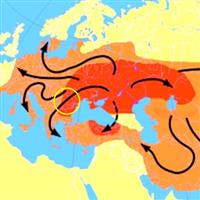
Brief History of the Great Migrations, left in history as the “great barbarian invasions”….

In Greek mythology, the Trojan War was preceded by several important events. At the wedding of Peleus and Thetis on Olympus, all the gods are invited except Eris, the goddess of discord. In revenge, she threw them a golden apple on which were the words ”For the most beautiful one”. Three goddesses, Hera, Athena and Aphrodite, claim the apple. In order to end the dispute, Zeus sends Hermes and the three goddesses to Mount Ida where lives Paris, a shepherd (in reality a Trojan prince) to choose the winner. Paris offers the apple to Aphrodite (Goddess of Love), who promised him the love of the most beautiful woman in the world (Elena). According to some versions, arriving in Sparta, he, with the help of Aphrodite, seduced Helen (who was the wife of Menelaus, king of Sparta), and convinced her to run away with him, or he kidnapped her and took her in Troy. Angry at this affront, Menelaus went to his brother Agamemnon, the most powerful of the Greek kings, and together they set out on a huge expedition to go to Troy, recover/ retrieve Helen, and destroy the city.
This was the reason and the beginning of the Trojan War, which lasted ten years, the end of which is told in the Iliad, an epic in 24 songs, attributed to Homer

The Trojan War is a legendary conflict in Greek mythology, the historicity of which is controversial and still debated.
Most classical Greeks believed that the war was a historical event, but many believed that the Homeric epic exaggerated the events to suit the requirements of the poem.
According to legends and myths, the war was started by the Trojan prince Paris who kidnapped (or seduced) Helen, the wife of the king of Sparta, Menelaus.
In retaliation, Menelaus, the cheated husband, and his brother Agamemnon, along with most of the Greek kings, set out on an expedition to besiege Troy.
In the Iliad, the deeds of exceptional bravery performed by fearless heroes, such as Ajax, Achilles, Hector or Patrocles, and the way in which the gods and goddesses intervened directly in support of the two camps are recounted.
The Iliad is an epic composed of 24 songs, attributed to Homer, in which the tenth year of the Trojan War is narrated, being considered a founding work of Greek culture, then of Roman culture, and has been a source of inspiration for many artists and writers.

The Trojan War and its aftermath were the subject of a vast epic cycle, the “Trojan cycle”.
Achilles’ victory, killing the Trojan leader Hector in direct combat, did not end the war.
In the end, the Achaeans manage to enter the city, through the tricks of the Trojan horse.
The Greeks then burned the city to the ground and divided the spoils and slaves taken prisoner.
The war between the Trojans and the Achaeans lasted ten years, during which many heroes died, both from the camp of Hellas (Achilles, Ajax, Patrocles) and from that of Troy (Hector, King Priam and his son Paris).
What happened after the end of the Trojan War is told in the Odyssey and the Aeneid.

on February 17, 1600, Giordano Bruno (1548-1600), one of the most courageous thinkers of the Renaissance, was burned at the stake for heresy, in Campo dei Fiori in Rome, for his pantheistic conception and for his beliefs that the Universe is infinite, because they contradicted religious dogmas about God’s creation.
In the history of thought, over the centuries he remained a landmark as a martyr of free and anti-dogmatic thought.
Copernicus’ heliocentric theory gave him a starting point for what he called a “new philosophy”.
He can claim to be the first thinker of the Middle Ages who integrated metaphysics, physics, psychology and ethics into an original philosophy, which aspired to go beyond the re-elaboration of Platonism, Aristotelianism or skepticism in a Christian context that until then prevailed.
He rejected the axioms of Aristotle’s natural philosophy which assumed that the universe was finite.
Bruno argued that the Universe was infinite, animated and populated by countless solar systems. It was also eternal.
As such, the Universe knew all possibilities at any given moment, and in all parts of it throughout time, constituting the cognitive manifestation of a timeless and absolute principle, God, conceived as the only being that truly existed.
The result was a radical alternative to medieval and Renaissance interpretations of human nature, the cosmos, and God.
His ideas and works influenced the science and philosophy of the centuries that followed.
Galileo, Newton, Huygens, Leibniz, Spinoza, developed some works starting from his ideas.

The archaeological record of early human history outlines the way of life in Upper Paleolithic human groups (ca. 50,000 -12,000 years ago).
There was a long period of tens of thousands of years when Women’s Day was not celebrated, although women of that time had an important role in the communities of primitive people living then.
Men were mainly engaged in hunting, making tools and fighting with other bands for territories and protection.
In addition to helpers and partners in activities that did not require brute force, women’s main mission was to give birth, nurse and raise children, which ensured the continuity of the existence of the group/gang of which they were a part.
Starting approximately 40,000 years ago, representations (statuettes) of women appeared, considered perhaps even as goddesses, and probably as symbols of fertility and procreation, illustrated by the hypertrophy of the characteristic female forms, so different from the female models of our days. .
They are considered by some archaeologists and historians to represent the prehistoric idea of female beauty, and were therefore called “Venus” in reference to the Roman goddess of beauty.
Venus figurines were discovered over a wide geographical area and spaced out in time by tens of thousands of years, which can say that they were the preferred female models in the Paleolithic (durations of time difficult to represent for us, who only count years and centuries…) .
These statuettes are known to be some of the earliest works of prehistoric art.

Among the many myths and legends inherited by antiquity, there are some that I consider essential myths for defining the human condition – Prometheus, Sisyphus, Icarus, Oedipus.
The myth of Prometheus endured for almost 3000 years.
The myth interested philosophers, poets, prose writers, playwrights, composers, being a source of inspiration for other arts as well (painting and sculpture, in particular). who evoked it, with the means and ideas specific to their art.
The legend of Prometheus is a common theme in ancient and modern culture.
That is why in this first powerpoint the main versions of the myth, as they have come down to us, are presented.

The myth interested philosophers, poets, prose writers, playwrights, composers, being a source of inspiration for other arts as well (painting and sculpture, in particular). who evoked it, with the means and ideas specific to their art.
Part II presents interpretations of myth in European literature, from Hesiod and Aeschylus to Nietzsche and Kafka.

The myth of Prometheus has numerous interpretations in the works of some Romanian authors.
Some of these are presented in Part III.
The pps Trilogy on the Myth of Prometheus – Reading Notes, is dedicated to all those who have the patience and pleasure to browse and (re)read book and web pages on mythology…