


A poem known and recited by many actors.
Eminescu, as he was. Known and unknown photos, never-before-seen images, the testimonies of loved ones.
The Earth and the survival of our civilization are at great risk in this century, which could be the last in human history. There are several major threats and risks, some from natural causes that are difficult or impossible to prevent, others from human causes as a consequence of scientific, technological, social and cultural developments in human society. There are national and international research centers and institutes devoted to the study of Existential Risks, defined as “those threats that may result in the premature extinction of intelligent life originating on Earth, or the permanent and drastic destruction of its potential for future development”
Such Future Scenarios presents “WHAT COULD HAPPEN IF…”
So there is a degree of uncertainty and likelihood of some of the predictions made by some specialists coming true…
Please note that the data and information in these possible scenarios are at the level of the years in which each of them was realized (2012…2022)
They can be updated by consulting recent bibliographies in each subject area.
On March 16, 2024, we commemorated the 67th anniversary of Brancusi’s death.
In Romania a relatively small number of Brâncuș’s works are preserved, for known historical reasons, summarized in this quote from Ilarie Voronca:
“And suddenly I had the revelation of the creator’s solitude.
He who with his own hands made the world, was grieved to see that it was ungrateful and haughty, turning away from him and forgetting him. But just like any great artist, the creator continues his fantastic labor, without respite and never satisfied. My soul was filled with awe for the divine builder” ;
From an exegetical point of view, Brâncuș’s creation has known an extraordinary discrepancy of opinions.
Brancusi has been associated with the most varied artistic styles starting with Cycladic idols, African statuary, Greek archaic art, then the Egyptian, culminating with the rockets of the atomic age, after having previously been equally related to cubism, abstract art, Byzantine, oriental, Platonic spirituality and, last but not least, Romanian folklore.
This diversity of opinions is particularly evident at the stylistic turning point in the sculptor’s work, namely 1907-1910, the period in which the “Prayer”, “The Earth’s Rise” and “The Kiss” were created.
Many foreign researchers of his work point to elements of inspiration from our folklore (Paul Morand, Carola G., Welcker, Jean Cassou, Herbert Read); others such as Sidney Geist consider these elements to be of secondary value.
Romanian exegesis was oriented, naturally in a way, on the national specificity of Brâncuși’s creation.
These polemics around the work of the great Romanian sculptor seek to emphasize what is Romanian and what is universal in his creation.
His art has, without a doubt, renewed the meanings and orientation of sculpture, and therefore it must be received from the point of view of the cultural confluences that they reveal, which together make up a dialog with universal valences.
For an art lover open to the world of ideas and artistic currents that revolutionize the creation of artists and reshape the criteria of evaluation and perception/understanding of the public, the encounter with Brâncuși’s work is an overwhelming moment, entering a temple about whose symbols and artistic achievements have been written tens of thousands of pages in articles and volumes of presentation and analysis of the cognitive leap made by the father of modern sculpture.
There are authors who have devoted their entire lives to presenting and trying to explain Brâncuș’s works to the general public.
For some of his works that broke new ground in 20th century art, we have drawn on an extensive bibliography.
From these many volumes and pages, I have retained and synthesized what were for me some of the main ideas, in the Lecture Notes from the powerpoint presentations dedicated to the defining works of Brâncuși’s art.
We made these powerpoints on scientific topics that are rarely presented, based on an observation by the well-known scientist Stephen Hawking, who co-wrote “The Grand Design” with L. Mlodinow.
“It amazes me how disinterested we are today in things like physics, space, the universe and the philosophy of our existence, our purpose, our final destination. It’s a fantastic world out there. Be curious.”
I add another poignant formulation by another scientist, Steven Weinberg, winner of the 1979 Nobel Prize in Physics, who wrote, “The first three minutes, a modern view of the origin of Universe” “The effort to understand the universe is one of the rare things that raises human life a little above the level of a farce and gives it something of the thrill of tragedy.”
I dedicate these powerpoints to those who are curious, eager to find out what is currently known about how the world we live in began and how it may end.
Mr. Qfwfq, a very old gentleman, is the narrator and protagonist of stories written by Italo Calvino, collected in the volume COSMICOMICĂRII.
It’s about 13.7 billion years old.
And because he has lived so long and seen so much, he humorously tells us about the evolution, expansion and contraction of the Universe, time and space, stories about the transformation of matter, starting from current scientific notions and knowledge, mainly astronomical…
Due to some restrictions and particularities of the NICEPPS.ro website
where these Powerpoint presentations are hosted,
following the link mentioned for each of these presentations
that leads to the page where it can be found,
it is necessary to download them on your computer to watch them with music and text,
because on the NICEPPS website or on your phone, the music cannot be heard.

A poem known and recited by many actors.
Eminescu, as he was. Known and unknown photos, never-before-seen images, the testimonies of loved ones.


George Vraca was a very well-known and appreciated actor. Today we would say that his interpretation is “old school”. However, his grave voice fits well with the story of Luceafar Eminescian


No matter how many have been done and will be done, they will not be enough to pay tribute to Eminescu.

A masterpiece of universal lyricism deserves a recitation as…
Even if the current hard – soft technology has not reached the level of perfect synchronization between the text and the voice with inflections and unique timbral nuances of Gheorghe Cozorici, I hope that all those who cherished him and did not forget him will enjoy the two power point.

Continuation of part 2, Eminescu – Luceafarul-fragments, recitation by Gheorghe Cozorici
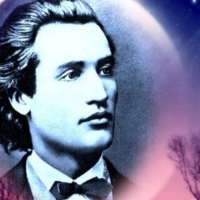
The Emimescian cosmogonic vision is based on the knowledge of the cosmogonies from the ancient Indian, Babylonian, Sumerian and Egyptian texts, to which he adds a lot of scientific knowledge.
No one before Eminescu and even after him has described with metaphors and inspired poetic images, in such suggestive and simple words, for everyone to understand, abstract scientific concepts and such complex cosmogonic theories.

The poem Epigonii was written by Eminescu when he was only 20 years old and represents the literary manifesto of the young Eminescu.
I invite you to (re)read it together, to remind us of Eminescu’s conception of the mission of poetry and the poet and his belief that the value of the literary work is given by the height of moral ideals and the beauty of the social and national message.

Dozens, hundreds of volumes, studies, analyses, commentaries, articles have been written about Eminescu’s love poetry.
I reread part of them and I thought I would present Caramitru’s recitation and some short reading notes about the poem “So tender”.

Many people read and love Eminence’s poems…
I thought of inviting lovers of Eminescu’s love poems to listen to a recitation and reading of some literary analyzes and comments of this special poem…

This sonnet is a processing of the modest text Venedig by the German poet Cajetan Cerri, written in 1850, the year of Eminescu’s birth, then translated into French by August Platen.
The Venice sonnet has 24 variants.
The first variant is an almost word for word translation from the German of Cerri’s sonnet.
The following variants were developed between 1869 and 1879-1880, reaching up to 1883.
Eminescu found, in Cajetan Cerri’s Venedig, motifs familiar to his poetic universe – time, life, death, ancient myths.
Romanian and foreign literary critics affirmed that Eminescu made, from a mediocre text, “one of the most beautiful poems of universal literature, an original masterpiece.”

On June 15, every year, poetry lovers bow before the grave of our great poet, EMINESCU…
The one who said in the ODA that “I didn’t think I could learn to die fast” left us earthlings, towards the Star of his Solitude, a unique star in the firmament of lyricism and universal thought…
To this commemorative day, and to those thoughts and feelings that gave birth to the depths and heights of the verses inlaid on this unique poetic monument, ODA in ancient meter, I bow with emotion, this powerpoint…

An indelible day in the history of the Romanian people. It is the day when Eminescu, our incomparable poet, thinker and visionary, started towards the uncontainable spheres of his immortality…
On June 15, 1889, around 4 am, he passed away.
In one of the pockets of the robe in which the poet had died, there was a small notebook.
The poems found in the notebook were written, his admirers said, in the last days of his life, and the last of them, an hour before his death. The poems have no title. The feeling of imminent death can be guessed from the lyrics.
This last poem, written shortly before he left a world that will not forget him for the universe of feeling and thought he created, however much the poor epigones of today try to banish him from our memory and soul.
I found two versions for the 3rd stanza of the poem in volumes published in 1953, 1964: “Some cities/Watching the vast/And the uncontainable/Loneliness.” (in newer sources, on the Internet) and “Some fortresses/Floating on the great/And moving/Desolations.” (in older sources, and I kept them both in powerpoint, not having access to the manuscripts.

Volumes of literary analyzes have been written about this Eminescian masterpiece.
The poem – an antithesis between the glorious past and the pitiful present, is structured in two parts.
From the study of the Eminescian manuscripts, it was found that the poet originally composed the second part.
Later, for contrast, the first part was added, the evocation of the battle of Rovine.
The length of the poem, which far exceeds the restrictive limits (size and duration) of a powerpoint, led me to present only some fragments, I think the best known from each part.
In Part I, Baiazid and Mircea – a glorious episode from the past of the ancient patriots “of which chroniclers and rhapsodies were worthy” is evoked
”– Are you Mircea?
– Yes, Your Highness!
– I demand you to kneel down,
Or I’ll lay upon your forehead a disgraceful thorny crown.
– I don’t really care, Your Highness, why you’ve come and what you do,
While we are at peace, however, I shall warmly welcome you!”

Part II of Saltimbancii and irozii, is a satire on politicians, their demagoguery and false patriotism. “They have the present, isn’t it great? He won’t give me what I’m going to ask for? I won’t find among our people a towering jewel?”

Our Eminescu, the genius of Romanian and universal poetry, the one who gave us the priceless treasures of his thoughts, experiences and feelings, so overwhelming through the beauty and unparalleled depth of his verses.
The failed attempts of detractors older and newer have collapsed into the nothingness that gave birth to them.
He is for ages, and will remain for ages, the symbolic effigy of the Romanian nation. Never forgetting him, I paid tribute in several pps to his huge stature as a Romanian poet, thinker and patriot.

Dintre toate motivele eminesciene legate de natură, cel mai des întâlnit este LUNA, un motiv romantic universal, încărcat de simboluri și semnificații.
Universul nocturn eminescian este feeric și senin, mirific și luminos.
Imaginile Lunii la Eminescu sunt asemănătoare cu cele din lirica sanscrită în care, de obicei, luna trezeşte durere și dragoste.
Concepţia despre Lună a lui Eminescu, ca o putere care învie gânduri și întunecă suferinţe își are originea în concepţia vedică despre Varuna, zeul cerului.
Văpaia Lunii transpune poetul la un alt nivel spiritual și îi dezvăluie tainele creaţiei și ale vieţii oamenilor.
Astrul selenar împreună cu toate celelalte elemente ale cadrului natural, contribuie la realizarea atmosferei eminesciene de extaz şi somnie, căreia este greu să-i găsim un echivalent nu numai în poezia română dar şi în cea universală.