Extra Professional
Interests and Activities

Artificial intelligence

The Earth and the survival of our civilization are at great risk in this century, which could be the last in human history. There are several major threats and risks, some from natural causes that are difficult or impossible to prevent, others from human causes as a consequence of scientific, technological, social and cultural developments in human society. There are national and international research centers and institutes devoted to the study of Existential Risks, defined as “those threats that may result in the premature extinction of intelligent life originating on Earth, or the permanent and drastic destruction of its potential for future development”
Such Future Scenarios presents “WHAT COULD HAPPEN IF…”
So there is a degree of uncertainty and likelihood of some of the predictions made by some specialists coming true…
Please note that the data and information in these possible scenarios are at the level of the years in which each of them was realized (2012…2022)
They can be updated by consulting recent bibliographies in each subject area.

On March 16, 2024, we commemorated the 67th anniversary of Brancusi’s death.

In Romania a relatively small number of Brâncuș’s works are preserved, for known historical reasons, summarized in this quote from Ilarie Voronca:

“And suddenly I had the revelation of the creator’s solitude.
He who with his own hands made the world, was grieved to see that it was ungrateful and haughty, turning away from him and forgetting him. But just like any great artist, the creator continues his fantastic labor, without respite and never satisfied. My soul was filled with awe for the divine builder”
;

From an exegetical point of view, Brâncuș’s creation has known an extraordinary discrepancy of opinions.

Brancusi has been associated with the most varied artistic styles starting with Cycladic idols, African statuary, Greek archaic art, then the Egyptian, culminating with the rockets of the atomic age, after having previously been equally related to cubism, abstract art, Byzantine, oriental, Platonic spirituality and, last but not least, Romanian folklore.

This diversity of opinions is particularly evident at the stylistic turning point in the sculptor’s work, namely 1907-1910, the period in which the “Prayer”, “The Earth’s Rise” and “The Kiss” were created.

Many foreign researchers of his work point to elements of inspiration from our folklore (Paul Morand, Carola G., Welcker, Jean Cassou, Herbert Read); others such as Sidney Geist consider these elements to be of secondary value.

Romanian exegesis was oriented, naturally in a way, on the national specificity of Brâncuși’s creation.

These polemics around the work of the great Romanian sculptor seek to emphasize what is Romanian and what is universal in his creation.

His art has, without a doubt, renewed the meanings and orientation of sculpture, and therefore it must be received from the point of view of the cultural confluences that they reveal, which together make up a dialog with universal valences.

For an art lover open to the world of ideas and artistic currents that revolutionize the creation of artists and reshape the criteria of evaluation and perception/understanding of the public, the encounter with Brâncuși’s work is an overwhelming moment, entering a temple about whose symbols and artistic achievements have been written tens of thousands of pages in articles and volumes of presentation and analysis of the cognitive leap made by the father of modern sculpture.

There are authors who have devoted their entire lives to presenting and trying to explain Brâncuș’s works to the general public.

For some of his works that broke new ground in 20th century art, we have drawn on an extensive bibliography.

From these many volumes and pages, I have retained and synthesized what were for me some of the main ideas, in the Lecture Notes from the powerpoint presentations dedicated to the defining works of Brâncuși’s art.

We made these powerpoints on scientific topics that are rarely presented, based on an observation by the well-known scientist Stephen Hawking, who co-wrote “The Grand Design” with L. Mlodinow.

“It amazes me how disinterested we are today in things like physics, space, the universe and the philosophy of our existence, our purpose, our final destination. It’s a fantastic world out there. Be curious.”

I add another poignant formulation by another scientist, Steven Weinberg, winner of the 1979 Nobel Prize in Physics, who wrote, “The first three minutes, a modern view of the origin of Universe” “The effort to understand the universe is one of the rare things that raises human life a little above the level of a farce and gives it something of the thrill of tragedy.”

I dedicate these powerpoints to those who are curious, eager to find out what is currently known about how the world we live in began and how it may end.

Mr. Qfwfq, a very old gentleman, is the narrator and protagonist of stories written by Italo Calvino, collected in the volume COSMICOMICĂRII.

It’s about 13.7 billion years old.

And because he has lived so long and seen so much, he humorously tells us about the evolution, expansion and contraction of the Universe, time and space, stories about the transformation of matter, starting from current scientific notions and knowledge, mainly astronomical…

Due to some restrictions and particularities of the NICEPPS.ro website
where these Powerpoint presentations are hosted,
following the link mentioned for each of these presentations
that leads to the page where it can be found,
it is necessary to download them on your computer to watch them with music and text,
because on the NICEPPS website or on your phone, the music cannot be heard.

We rediscovered the Lord’s Prayer – Our Father, the one we know and say since childhood, and its long history less known by many believers.
This history helped me to make several pps, of which I am posting today one that represents the unusual fusion, under the Light of Faith, of this Prayer, music and images created by an artificial intelligence software.

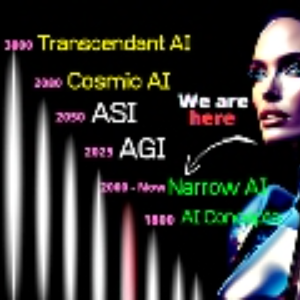
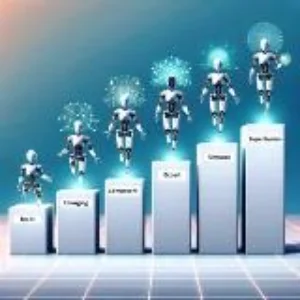
The term “artificial intelligence” is used to describe machines (computers, robots, apps) that mimic cognitive functions such as “learning” and “problem solving” that people associate with human minds. In this first pps are presented notions, concepts, and introductory definitions needed in this information stage.

Artificial intelligence (AI) is the defining technology of the last decade and perhaps the next, as it involves the development of algorithms and models that can mimic and even surpass human capabilities in many areas of work and life.

With the creation, evolution and exponential development of AI we are in the midst of an ongoing revolution that will have a much deeper economic and social impact than the previous two – the agrarian and industrial revolutions.

The evolution and advancements in artificial intelligence (AI), in the future, and after the launch of ChatGPT in late 2022, with the developments realized in 2023, and those announced for 2024, are presented synthetically in this powerpoint. I add that I HAVE USED ARTIFICIAL INTELLIGENCE MODELS to systematize some texts and create images that better illustrate, than those found on the Internet, this introductory presentation of artificial intelligence

Advances in artificial intelligence (AI) make national and international media headlines every day.

They discuss different points of view, with arguments FOR and AGAINST the development of advanced AI, which could represent a profound change in the history of life and society on Earth.

I add that I have interacted with models of artificial intelligence to develop texts and create images that better illustrate, than the documentation on the Internet, the presentation of opinions, arguments and reactions PRO and AGAINST artificial intelligence.

I mention that the music taken from Youtube, for the 3 powerpoints so far, was composed by artificial intelligence models.

It feels like the future can tilt between bright utopia and dystopian apocalypse.

Humanity is at a turning point. No one knows what will happen next.

That is why Scenarios are made, as possible alternatives, with different probability of realization.

Hundreds of articles and volumes have been written about these Scenarios, scientific debates and films have been made. In this pps we have used classic documentary sources (publications, Internet) and artificial intelligence programs to illustrate some of the main Scenarios presented and debated in the literature about the future of this extraordinary invention – Artificial Intelligence

We are at a crossroads of accelerated change, unlike anything that has happened in the history of life and mankind.

Reading the book Cioran si Muzică, with the thoughts and reflections of the philosopher considered an aristocrat of doubt, or a stylist of despair, and a music lover receptive to what the music of Bach, Mozart and other great composers can tell us, I thought of trying the illustration them only with the help of images generated with an Artificial Intelligence software, which can be an absolute first in this kind of work.

How inspired the idea was and its transposition into a powerpoint with images selected from those generated by Artificial Intelligence, can be evaluated.