These works opened new directions of study and action in the activity of Research, Policy and management of Science and Technology, and in the Economy.
The Internet R&D Network, the Reform and Changes of R&D Institutional System, the New and Green Economy, Remote work (telework) and the future of work, were elaborated and included in economy and society during the decade of 1990-2000 and afterward, and were presented at the governmental decision-making level.
Some of the concepts and proposals presented at that time were gradually implemented, both legislatively and administratively.
Full-length works can be sent to those who request them through the CONTACT form.
| E. Staicuţ, I. Popa, G. Macri, A. Toia |
Romanian National Computer Network for Research and Higher Education Staicut, Eugenie ( estaicut@roearn.ici.ro) Abstract This paper reviews the current status of the Romanian National Computer Network for Research and Higher Education (RNC), services provided and user community in the first stage of the development. Some lessons learned during this phase The first node ( ROEARN) was installed in December 1992 at Research Institute of Informatics in Bucharest and it was connected by leased line to Vienna University having only BITNET connectivity. Very soon some other nodes installed Exploring the network services it became very soon clear that the future of networking for research community is Internet, so only in few months, April 1993, Romania got Internet connectivity too. With the kind assistance of people Also, with help from European Community a second leased line between Bucharest and Amsterdam was installed in 1993 to allow a higher number of end user nodes to be connected. Communities being served by RNC include mainly: R&D; institutes; higher education universities; libraries; government and non-government institutions that coordinate activity in research and academic institutions, high schools. The paper presents the sources of funds, statistics regarding the total traffic, number of hosts, subdomains and users. The present configuration is star like. About 25 nodes are connected by leased lines to the international gateway To improve the line utilization for dialup access, POP server und UUCP protocols were installed for e-mail communications. Many programs from public domain are being used for giving acces to users. A variety of computer types (MicroVAX/VMS, User support is provided by personnel at each main site; technical assistance and training are offered for the connection of new users and initiation in using the network services. User documentation (in Romanian and English) and some The paper presents also some difficulties which were encountered during the first phase of development of RNC, mainly refered to the communication infrastructure, computer and human resources. Finally, the objectives for future developments, |
| Adrian Toia, Irina Roman |
The Main Guidelines of R&D Institutional System |
|
|
|
| Ana Vochin, Adrian Toia, Steliana Sandu, Gh. Zaman, Ileana Ionescu-Siseşti |
Dynamic Changes in the Romanian Research and Development System At the moment of the December 1989 Revolution, the Romanian scientific research and technologic development activity, as a whole, was in a state of emergency, completely blocked both in its functional mechanisms and structures, and in its relationship with the social-economic environment. The situation was so much the worse since previously, between 1965 and 1980, the scientific research and engineering and technological development activity had been a decisive factor in the rise and growth of the national industry in certain economic sectors able to satisfy the commands of extensive development (some of which were intrinsically highly competitive). We could safely say that at the end of the ’80s up to 80% of Romanian industry and economy would be accomplished due to the firsthand contribution of the scientific and technical productive power demonstrated by Romanian researchers and designers. Gradually after 1980 an obvious, yet officially well disguised gap occurred between research and design institutes, on the one hand, and productive enterprises on the other hand the latter failing to manifest interest in and admit the necessity and impact of scientific research.
Dynamic Changes in the Romanian Research and Development System.pdf |
| A. Toia |
Research market – old controversy under new conditions

Session II: The Effect of Globalisation on Science and Technology Management Abstract The paper presents a view concerning the old and new approach of science policy concept – “research market”. After a short presentation of theoretical problems,levels and main characteristics of the concept, the paper proposes some themes forreflection and action concerning tendencies, actors and mechanisms on the “researchmarket” , under 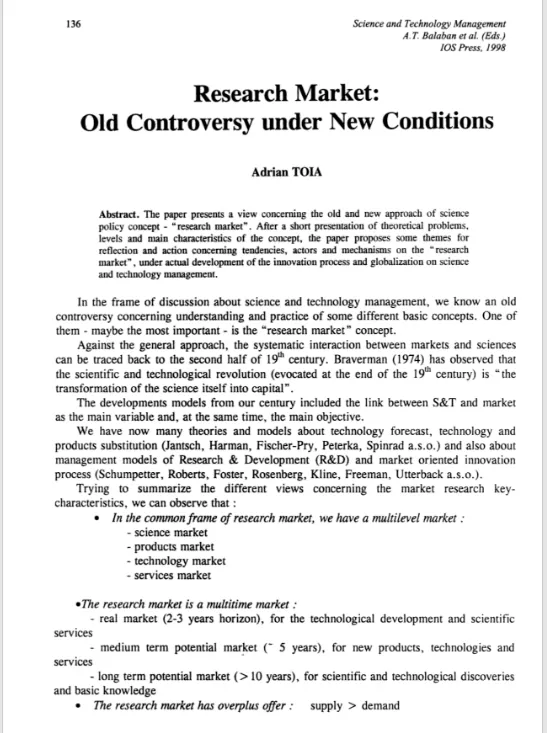 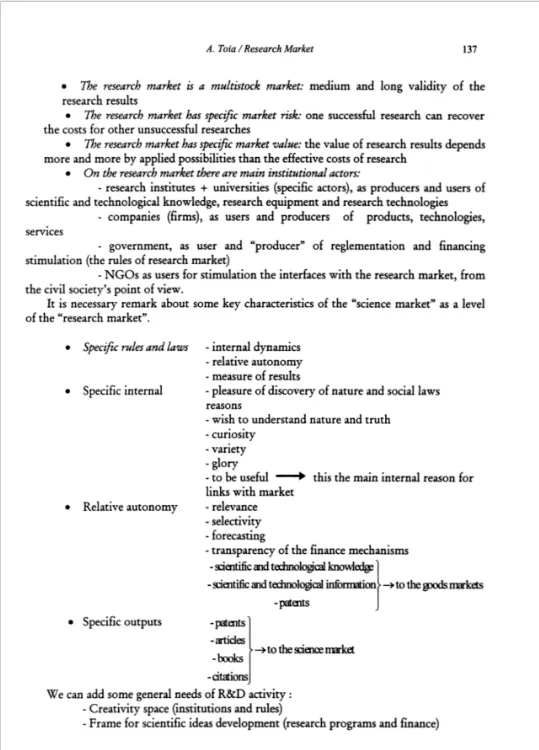 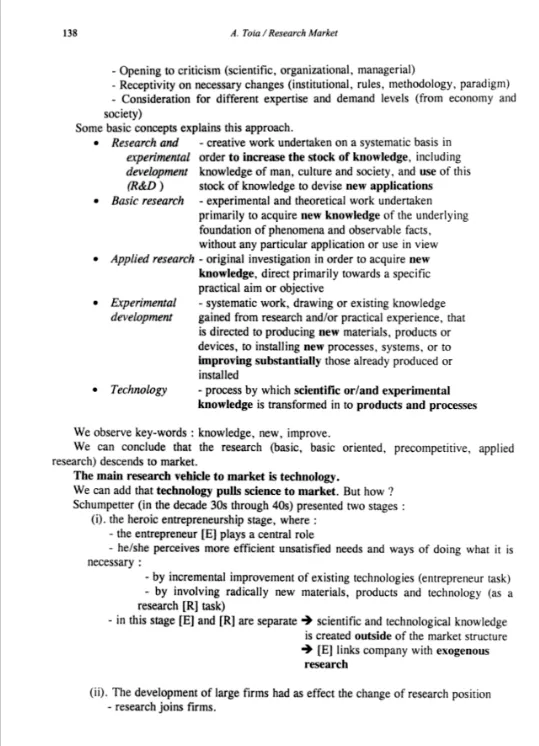
|
| A. Toia |
Telework – concept, fields of application, research directions |
  |
|
| A. Toia |
TELEWORK in Romania – from project to implementation |
| A. Toia |
E3WORK Project – eLearning-Module1 |
| A. Toia |
QUESTIONAIRE EMPLOYEES |
| A. Toia |
QUESTIONAIRE EMPLOYERS |